Africa
Africa is not merely a geographical setting in Jean-Baptiste Clamence's confession; it is a landscape of moral evasion, forced confinement, and the grotesque birth of a personal theology. It is the place where Clamence, having dodged the active fronts of World War II in Europe, finds himself paradoxically both a refugee from judgment and a prisoner who will be elected a pope. The continent functions as a crucible where his pretense of innocence is stripped away, replaced by the raw, unadorned mechanics of survival and authority.
Evasion and Arrival in North Africa
Clamence's journey to Africa is a direct consequence of his refusal to commit to the French Resistance. After a chance encounter with a dog at the Châtelet Station in Paris revealed his latent patriotism, he traveled to the Southern Zone of France with the intention of joining the underground. However, he found the prospect of "heroism of the depths"—the weaving in cellars and the risk of being beaten to death in hiding—incompatible with his temperament and his preference for "exposed heights." Unable to imitate such heroism, he crossed over to North Africa with the vague intention of reaching London. The situation there was, in his own words, not clear, with opposing parties seeming "equally right," allowing him to stand aloof. He eventually reached Tunisia, where a friend involved in the movies gave him work. This evasion, however, was short-lived; following the Allied landing in Algeria, both he and his friend were arrested by the Germans. Clamence was interned near Tripoli in a camp where the primary torments were thirst, destitution, and the elements—the heat, the vertical sun, the flies, the sand, and the lack of water—rather than outright brutality.
The Election as Pope in the Prison Camp
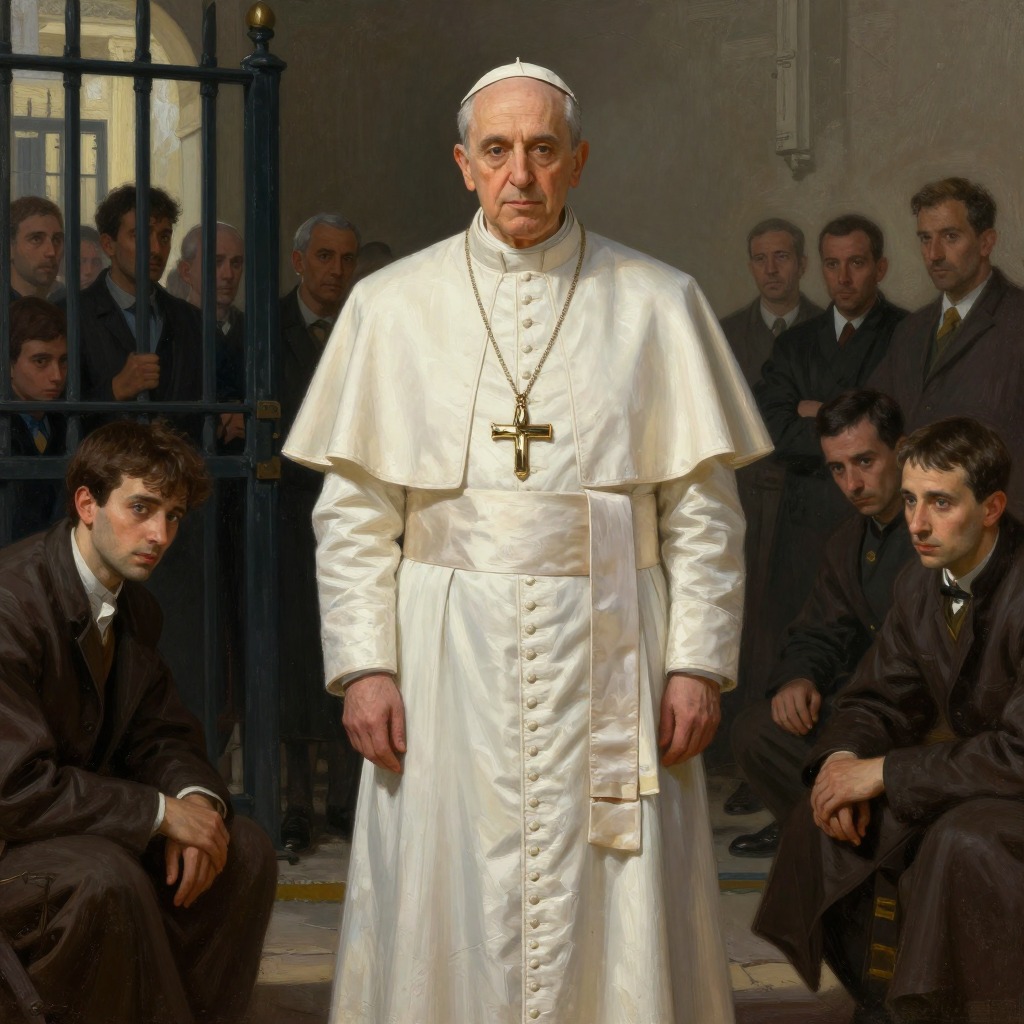
It was within this camp, under a tent that seemed to drip molten lead, that Clamence's most significant African experience unfolded. A young Frenchman, described as a "Du Guesclin type" with a profound melancholy, declared the need for a new pope who would live among the wretched. He proposed that they choose a man from among themselves, a complete man with vices and virtues, to keep alive the community of their sufferings. When he asked who among them had the most failings, Clamence, as a joke, raised his hand and was the only one to do so. The others, in a spirit that mixed jest with a trace of seriousness, elected him. Clamence exercised his pontificate for several weeks with increasing seriousness, acting as a group leader and administering the suffering of his comrades. The central problem was the water allotment, and Clamence was led to favor his own group, making concessions and giving advantages to certain men based on their condition or work. This experience taught him that it was not as easy as he had thought to be a pope, and it culminated in the act that closed the circle of his African ordeal: he drank the water of a dying comrade, convincing himself that the others needed him more and that he had a duty to keep himself alive for them. This act, he reflects, is how empires and churches are born under the sun of death.
Thematic Significance: A Landscape of Guilt and Authority
Africa, in Clamence's narrative, is the antithesis of the lofty summits and clear, sunlit landscapes he craves. It is a place of horizontal, crushing heat and confinement, a "soggy hell" of sand and flies. It is here that his abstract theories about innocence and guilt are tested in the most elemental way. The camp becomes a microcosm of the world he later describes, where every man testifies to the crime of all others. His election as pope is a dark parody of spiritual authority, born not from grace but from a shared, desperate guilt. The act of drinking the water of a dying man is the foundational sin of his pontificate, a moment that mirrors the larger crime of humanity he later accuses himself and everyone else of: the willingness to let others die so that one may live. Africa, therefore, is not a place of escape but of a more profound and inescapable entrapment, a prelude to the "little-ease" of his life in Amsterdam. It is where he first learned to dominate by confessing his own infamy, a technique he would perfect as a judge-penitent.